

You’re at a wedding. The dance floor is packed. People are laughing, spinning, and singing along to a song nobody actually knows the words to. Your friend is right in the middle of it, arms in the air, having the time of their life.
Meanwhile, you’re standing near the bar, nursing a drink you’ve been holding for forty-five minutes, watching the chaos unfold like a nature documentary. You’re having a perfectly fine time, but the idea of joining that dance floor feels less like fun and more like a war crime.
Two people. Same wedding. Same music. Same opportunity.
Completely different experiences.
That’s the introvert vs extrovert divide in a nutshell. It’s not about who’s more social, who’s happier, or who’s doing life right. It’s about where you get your energy and how much stimulation you can comfortably handle.
So let’s dig into what the real differences are — and why understanding them might just change how you see yourself and everyone around you.
The Core Difference: Where You Get Your Energy
This is the single most important thing to understand.
Introverts draw energy from within. Solitude, quiet reflection, and low-stimulation environments recharge their batteries. Social interaction — even enjoyable social interaction — drains them.
Extroverts draw energy from the outside world. Other people, exciting activities, and high-stimulation environments fuel them. Being alone — even pleasant alone time — drains them.
Think of it like this:
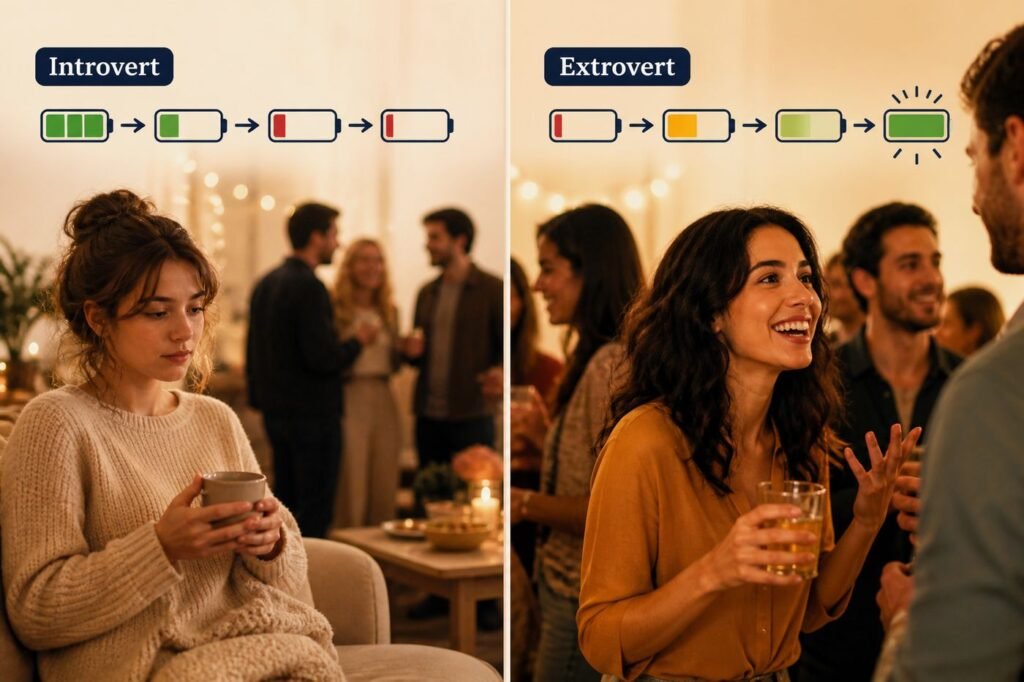
An introvert’s social battery starts at 100% at the beginning of a party and drains down to 0% over the course of the evening.
An extrovert’s social battery starts at 0% and recharges as the party goes on.
This isn’t a metaphor. It’s a real neurological difference in how their brains process stimulation.
The Stimulation Sweet Spot
Everyone has an optimal level of stimulation — a “sweet spot” where they feel alert, engaged, and comfortable.
The difference between introverts and extroverts is where that sweet spot is.
Introverts: The Overstimulation Risk
Introverts have a naturally higher baseline level of arousal. Their brains are already processing a lot of information, even when they’re not doing anything particularly stimulating.
This means they hit their optimal stimulation level quickly — and exceed it just as quickly.
Add a crowded room, loud music, and multiple conversations happening at once, and the introvert’s brain is suddenly overwhelmed. They’re not being dramatic. Their nervous system is genuinely overloaded.
Extroverts: The Understimulation Risk
Extroverts have a naturally lower baseline level of arousal. Their brains need more input to reach that optimal sweet spot.
A quiet evening at home might feel pleasant enough, but it doesn’t give them the stimulation their brain craves. They need excitement, interaction, and activity to feel truly engaged.
This is why extroverts often seem to thrive in environments that introverts find exhausting. Their brains are wired to need that level of input.
How Introverts and Extroverts Process Differently
Beyond energy and stimulation, there are fundamental differences in how the two personality types process information.
Aspect
- Introverts
- Extroverts
Thinking
- Think first, speak later
- Speak to think
Processing
- Internal processing
- External processing
Decision-making
- Need time to reflect
- Decide through conversation
Problem-solving
- Prefer to work through things alone
- Prefer to talk things through
Learning
- Prefer reading and reflection
- Prefer discussion and hands-on experience
Memory
- Strong internal recall
- Strong environmental association
The Social Differences
This is where most people focus their attention — and often where the stereotypes come from.
Social Energy
Introvert: Socializing costs energy. Even with people they love, they need breaks. They prefer shorter, more meaningful interactions.
Extrovert: Socializing creates energy. They feel revitalized by being around others. They prefer longer, more frequent interactions.
Social Circles
Introvert: Prefers a small number of close, deep relationships. Quality over quantity.
Extrovert: Prefers a larger network of relationships. Enjoys meeting new people and maintaining many connections.
Conversation Style
Introvert: Prefers deep, meaningful conversations. Dislikes small talk. Often quiet in groups.
Extrovert: Enjoys both light and deep conversation. Feels comfortable with small talk. Often talkative in groups.
Social Stamina
Introvert: Has a limited social battery. Needs recovery time after social events.
Extrovert: Has a seemingly endless social battery. Feels drained by prolonged isolation.
The Communication Differences
Have you ever noticed that some people need to talk through their thoughts while others need to think before they talk?
That’s introversion and extroversion in action.
Introverts: Think First, Speak Later
If you’re an introvert, you probably process information internally. You form your thoughts before you express them. You might even rehearse what you’re going to say before you say it.
This means:
You’re less likely to say something you regret
You often have well-formulated opinions
But you might miss your chance to speak up in fast-moving conversations
Extroverts: Speak to Think
Extroverts often process information externally. They develop their ideas by talking about them. They might not know what they think until they hear themselves say it.
This means:
They’re quick to contribute to conversations
They often think on their feet
But they might say things they haven’t fully thought through
Neither approach is better. They’re just different. But they can cause friction when people don’t understand the other person’s style.

The Workplace Differences
The modern workplace often favors extroverted tendencies. Open offices, brainstorming meetings, and constant collaboration can leave introverts feeling exhausted and unseen.
But that doesn’t mean introverts can’t thrive at work. They just thrive differently.
Introvert Work Strengths
- Deep focus and concentration
- Careful, thoughtful decision-making
- Strong written communication
- Independent problem-solving
- Listening and observation skills
- Detail-oriented work
- Extrovert Work Strengths
- Networking and relationship-building
- Quick thinking and adaptability
- Strong verbal communication
- Team collaboration
- Enthusiasm and energy
- Persuasive presentation skills
The best workplaces recognize that both types are valuable and create environments where everyone can contribute their best.
Common Misconceptions About Both Types
Let’s clear up some stereotypes.
Misconceptions About Introverts
“Introverts are shy.” Shyness is anxiety. Introversion is energy preference. They’re different traits.
“Introverts don’t like people.” Many introverts deeply love their people. They just have limits.
“Introverts are antisocial.” They’re often selectively social. They choose quality over quantity.
“Introverts are unhappy.” Introverts are perfectly happy — they’re just happy in quieter ways.
Misconceptions About Extroverts
“Extroverts are shallow.” Extroverts can be deeply thoughtful. They just express it differently.
“Extroverts can’t be alone.” They may prefer company, but they can function alone.
“Extroverts aren’t good listeners.” They listen differently — and can be excellent listeners when they choose to be.
“Extroverts are always the center of attention.” Not necessarily. Many extroverts are quiet, reserved people who simply prefer company.
The Ambivert: The Middle Ground
Here’s something that often gets overlooked: not everyone is clearly introverted or extroverted.
Ambiverts have traits of both. They might:
Enjoy socializing but need alone time to recover
Feel energized by some social situations and drained by others
Adapt their behavior depending on the context
Sit right in the middle of the introvert-extrovert spectrum
Most people actually fall somewhere in the middle. The “pure” introvert or extrovert is less common than you might think.
If you’re an ambivert, you might feel confused by personality tests that try to put you in a box. You might relate to introvert experiences some days and extrovert experiences other days. That’s perfectly normal.
The Science Behind the Difference
This isn’t just psychology — it’s biology.
Brain Differences
Research has shown that introverts and extroverts actually have different brain activity:
Introverts have more active blood flow in the frontal lobes and anterior thalamus — areas associated with planning, decision-making, and internal processing.
Extroverts have more active blood flow in the posterior thalamus and insula — areas associated with sensory processing and external awareness.
Neurotransmitter Differences
As mentioned in the Complete Guide, introverts and extroverts respond differently to key neurotransmitters:
Extroverts are more sensitive to dopamine. Social rewards feel more rewarding to them, which drives them to seek more social interaction.
Introverts are more sensitive to acetylcholine. Solitary activities that require attention and reflection feel more rewarding to them.
Genetics
Studies of twins suggest that introversion and extroversion have a significant genetic component. If your parents are introverts, you’re more likely to be an introvert — though environment also plays a role.
Relationships Between Introverts and Extroverts
Here’s where things get interesting.
Introverts and extroverts can have incredibly strong relationships — romantic, platonic, and professional. But they require understanding.
Common Challenges
Social expectations: One person wants to go out. The other wants to stay in. Neither is wrong.
Energy mismatch: One person feels energized by the same activity that drains the other.
Communication styles: One talks through problems. The other needs time to think.
Misinterpretation: The introvert might seem disengaged. The extrovert might seem overwhelming.
What Makes It Work
Understanding the other person’s needs — not just tolerating them
Compromise: Going out sometimes. Staying in sometimes.
Clear communication: “I need some quiet time” without defensiveness
Respecting differences: Not trying to change the other person

Rirely Humor Moment
A few observations about the introvert vs extrovert dynamic:
An introvert and extrovert walk into a bar. The extrovert immediately starts talking to everyone. The introvert immediately starts calculating the earliest possible escape time. They’re both confused by the other’s behavior.
Extroverts don’t understand why introverts need to “prepare” for social events. Introverts don’t understand why extroverts need to “recover” from being alone. It’s a mutual mystery.
The extrovert’s idea of a perfect weekend: brunch with friends, a party Saturday night, and a group hike Sunday. The introvert’s idea of a perfect weekend: a bookstore, Netflix, and absolutely zero notifications.
Frequently Asked Questions
Is one personality type better than the other?
No. Both introverts and extroverts have strengths and challenges. The world needs both.
Can an introvert become an extrovert?
Your core preference is relatively stable, but you can develop social skills and adapt your behavior. You might learn to enjoy certain social situations more, but you’ll probably still need solitude to recharge.
How do I know if I’m introverted or extroverted?
Pay attention to how you feel after socializing. Drained? Probably introverted. Energized? Probably extroverted. You can also take personality assessments, but self-observation is often the best guide.
Can introverts and extroverts have successful relationships?
Absolutely. Many of the best relationships are between introverts and extroverts. The key is understanding, compromise, and communication.
What’s the extrovert version of needing alone time?
Extroverts need social interaction to recharge. When they’re isolated for too long, they can feel drained, restless, and even depressed. They need connection like introverts need solitude.
Is introversion becoming more accepted?
Yes. There’s growing awareness that introversion is a normal personality trait, not a flaw. More people are recognizing and embracing their introverted nature.
Summary
The introvert-extrovert difference comes down to one core factor: where you get your energy.
Introverts recharge through solitude and quiet. Socializing drains them — even when they enjoy it.
Extroverts recharge through social interaction and activity. Being alone drains them — even when they’re comfortable.
Everything else — communication style, social preferences, work habits — flows from that fundamental difference.
Neither is better than the other. They’re simply different ways of experiencing the world. Understanding that difference can improve your relationships, your career, and your sense of self.
If you’re an introvert, you’re not broken. If you’re an extrovert, you’re not shallow. If you’re an ambivert, you get the best of both worlds — and the challenges too.
The goal isn’t to change who you are. It’s to understand who you are — and to build a life that honors it.
The Complete Guide to Introverts — The foundation for understanding introversion.
15 Signs You’re an Introvert — Check your own experiences against these common signs.
Are You an Introvert or Just Shy? Here’s the Difference — Understanding the crucial distinction.
Why Do Introverts Need Alone Time? The Science Behind Your Social Battery — The neurology of introversion.
10 Things Introverts Wish Extroverts Understood — A guide for the extroverts in your life.
Express Yourself
Whether you’re an introvert, extrovert, or somewhere in between, your personality deserves to be celebrated.
Rirely’s collection includes designs for everyone on the spectrum:
“Social Battery: Low” — For the introverts who need their space
“Powered by Coffee” — For the extroverts who need fuel for their adventures
“Professional Overthinker” — For the deep thinkers in every category
Find the design that matches your personality.
Explore More with Rirely
Want more personality insights, relatable observations, and the occasional painfully accurate take? Join the Rirely newsletter.
It’s free. It’s not spammy. And it might just help you discover something new about yourself.
Discover yourself. Express yourself.