

You’re in a meeting. The conversation is moving fast. People are talking over each other, throwing out ideas, building on each other’s energy. The room feels alive.
And you’re sitting there, quiet, taking it all in.
You have thoughts. You have ideas. You have a perspective that nobody else has mentioned yet. But the pace of the conversation doesn’t leave room for you to process and respond in your usual way.
Later, someone says to you: “You should speak up more. You’d make a great leader if you were more… you know… outgoing.”
And you wonder: Can introverts be good leaders? Or is leadership reserved for people who thrive in the spotlight?
The answer might surprise you.
The Leadership Stereotype
Let’s start with the obvious: leadership has a stereotype problem.
When most people picture a leader, they imagine someone who is:
- Charismatic and commanding
- Quick to speak and decisive
- Comfortable in the spotlight
- Energized by crowds and constant interaction
- Loud, visible, and always “on”
That’s the extrovert ideal. And it’s dominated our cultural image of leadership for decades.
But here’s the thing: introverts can be excellent leaders. In fact, some of the most effective leaders in history have been introverts — and research suggests they often outperform their extroverted counterparts in certain situations.

Why Introverts Make Strong Leaders
Introversion brings a set of leadership strengths that are often overlooked — but incredibly valuable.
1. They Listen — Really Listen
Introverted leaders are often exceptional listeners. They don’t just wait for their turn to speak — they actually take in what others are saying.
This matters because listening is one of the most underrated leadership skills. When team members feel heard, they’re more engaged, more loyal, and more willing to contribute.
2. They Think Before They Act
Introverts process internally. They consider options. They weigh consequences. They don’t rush to make decisions just to appear decisive.
This thoughtfulness can lead to better decisions, fewer mistakes, and more strategic thinking.
3. They Empower Others
Extroverted leaders sometimes dominate conversations without realizing it. Introverted leaders often create space for quieter team members to contribute — because they understand what it’s like to be overlooked.
This can lead to more diverse ideas, more inclusive teams, and better outcomes.
4. They Build Deep Relationships
Introverts don’t collect contacts. They build relationships. They invest in the people around them, get to know them on a deeper level, and foster loyalty that goes beyond the surface.
5. They Stay Calm Under Pressure
Introverts are often calm, steady, and measured in stressful situations. They don’t react impulsively. They take a breath, assess the situation, and respond thoughtfully.
In a crisis, that steadiness is invaluable.

What the Research Says
This isn’t just anecdotal. There’s real research behind introverted leadership.
The “Quiet Leader” Advantage
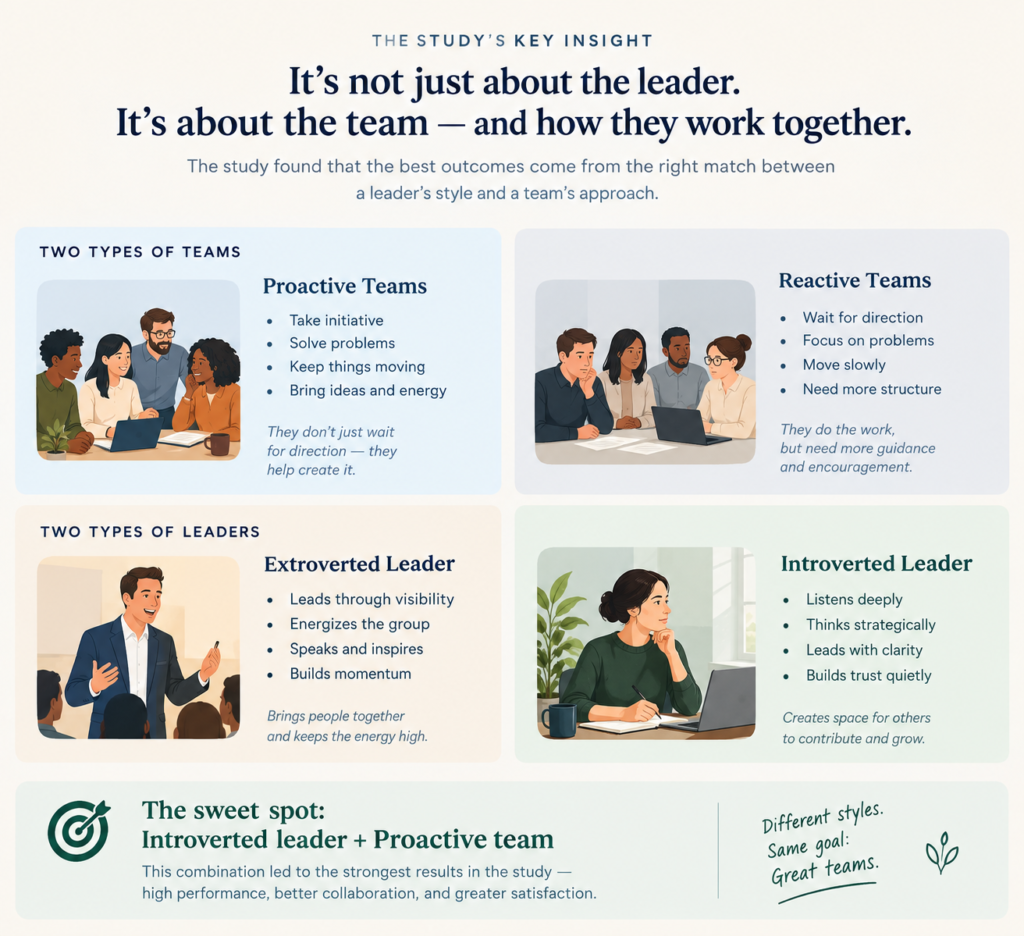
A well-known study from Harvard Business School found that introverted leaders can be more effective than extroverted leaders when managing proactive teams — teams where people are eager to share ideas and take initiative.
Why? Because introverted leaders are more likely to listen to those ideas rather than dominate the conversation. They let their team members shine.
The Extrovert Advantage
That same study found that extroverted leaders can be more effective when managing passive teams — teams that need direction and motivation. In those situations, an extrovert’s energy and charisma can inspire action.
The takeaway: there’s no single “best” leadership style. Different situations call for different strengths. And introverts bring a set of strengths that are often exactly what’s needed.
The Challenges Introverts Face as Leaders
It’s not all smooth sailing. Introverted leaders do face real challenges.
1. Visibility and Self-Promotion
Leadership often requires visibility — presenting to stakeholders, networking, being “on” in public settings. For introverts, these activities can be draining.
2. The Pressure to Perform Extroversion
There’s often pressure on introverted leaders to act more extroverted. To speak louder. To be more “charismatic.” To fill the silence. This can feel inauthentic and exhausting.
3. Social Fatigue
Leadership is inherently social. Meetings, one-on-ones, team events, difficult conversations — the social demands add up. Without proper recovery time, introverted leaders can burn out.
4. Being Underestimated
Because introverts don’t fit the stereotypical leader mold, they’re often underestimated. People might mistake their quietness for weakness, their thoughtfulness for indecision.

How Introverts Can Lead Effectively
If you’re an introvert in a leadership role — or aspiring to be — here’s how to make it work.
1. Play to Your Strengths
Lean into what you do well. Listen deeply. Think strategically. Build strong relationships. Empower your team. Create space for others.
You don’t need to be the loudest voice in the room. You need to be the most thoughtful one.
2. Manage Your Energy
Leadership is a marathon, not a sprint. You need to protect your energy.
- Schedule recovery time after big social events
- Block out quiet time in your calendar
- Build a team that respects your need for focus
- Say no to obligations that drain you without adding value
3. Communicate Clearly
Introverts often excel at written communication. Use it.
- Send thoughtful emails and memos
- Prepare for meetings in advance
- Write down your thoughts before sharing them
- Use one-on-one conversations to go deeper
4. Be Authentic
You don’t need to pretend to be an extrovert. In fact, authenticity is one of the most powerful leadership qualities.
When you show up as yourself — quiet, thoughtful, and genuine — you give your team permission to do the same.
5. Find Your Leadership Style
There’s no one way to lead. Find the style that works for you.
- The listener: You lead by hearing others.
- The strategist: You lead by thinking deeply.
- The calm presence: You lead by staying steady in chaos.
- The relationship-builder: You lead by knowing your people.
None of these require extroversion. All of them are powerful.
(

How Introverts Can Be Good Leaders
The question isn’t whether introverts can be good leaders. The question is: what kind of leader will you be?
Introverted leaders are:
- Calm in a crisis — They don’t panic. They assess and respond.
- Thoughtful in decisions — They don’t rush. They consider.
- Deep in relationships — They don’t collect people. They invest.
- Inclusive in teams — They don’t dominate. They empower.
- Steady in pressure — They don’t react. They endure.
These aren’t weaknesses. They’re strengths.

What Introverts Wish Their Teams Understood
If you’re an introvert leading a team, here’s what you might wish your team knew:
- Quiet doesn’t mean disengaged. I’m thinking, listening, processing.
- I need time to respond. Don’t rush me. I’ll give you a better answer if I have a moment.
- I’m not ignoring you. I’m just not always available for spontaneous conversation.
- I lead differently. I don’t need to be loud to be effective.
- I value one-on-one time. It’s where I do my best work.
- I notice everything. Just because I don’t comment doesn’t mean I don’t see.
Rirely Humor Moment
Introvert leadership style:
- Extroverted leader: “Let’s brainstorm! Everyone shout out ideas!”
- Introverted leader: “Let’s think about this individually and reconvene tomorrow.”
The introverted leader’s superpower: making everyone else feel heard while quietly thinking five steps ahead.
Extroverted leader at a company retreat: “Let’s do icebreakers!”
Introverted leader, internally: “I will resign before I do an icebreaker.”
An introverted leader doesn’t need to be the loudest person in the room. They just need to be the one who actually listens when everyone else is talking.
Frequently Asked Questions
Can introverts be good leaders?
Yes. Introverts can be excellent leaders, often bringing strengths like deep listening, thoughtful decision-making, and the ability to empower others.
Are introverts better leaders than extroverts?
Neither is inherently better. Research suggests introverted leaders can excel with proactive teams, while extroverted leaders can excel with passive teams. The best leadership style depends on the situation and the people.
How can introverts lead without being drained?
Introverted leaders can manage their energy by scheduling recovery time, using written communication when possible, building a supportive team, and protecting their quiet time.
Do introverted leaders need to act extroverted?
No. Authenticity is more effective than pretending to be someone you’re not. Introverted leaders can lead effectively by playing to their natural strengths.
What are examples of introverted leaders?
Some well-known introverted leaders include Abraham Lincoln, Rosa Parks, Bill Gates, Warren Buffett, and Barack Obama. Many successful leaders have been introverts.
How do introverts handle networking as a leader?
Introverts can network effectively by focusing on one-on-one conversations, preparing in advance, using online platforms, and setting boundaries around their energy.
Summary
The question “Can introverts be good leaders?” has a clear answer: yes.
Introverts bring unique strengths to leadership:
- Deep listening
- Thoughtful decision-making
- Empowering others
- Building meaningful relationships
- Staying calm under pressure
They face challenges too — visibility, social fatigue, being underestimated. But with the right strategies, they can lead effectively and authentically.
You don’t need to be the loudest person in the room to lead. You just need to be the one who listens, thinks, and cares. That’s what real leadership looks like.
Continue Exploring
- The Complete Guide to Introverts — The foundation for understanding introversion.
- Do Introverts Get Lonely? — Understanding solitude vs. loneliness.
- Why Do Introverts Take So Long to Reply to Texts? — Understanding introvert communication.
- How Introverts Make Friends — Building meaningful connections.
- 10 Things Introverts Wish Extroverts Understood — A guide for the people who don’t quite get it.
Express Yourself
If you’re an introvert who leads quietly, Rirely’s collection helps you express it:
- “Social Battery: Low” — For when you need people to know you’re running on empty.
- “Professional Overthinker” — For the introvert whose mind never stops.
- “Mentally Somewhere Else” — For the introvert who’s present but also deeply internal.
- “Do Not Disturb: Recharging” — A clear signal for your quiet time.
Find the design that matches your personality.
Explore More with Rirely
Want more personality insights, relatable observations, and the occasional painfully accurate take? Join the Rirely newsletter.
It’s free. It’s not spammy. And it might just help you discover something new about yourself.
Discover yourself. Express yourself.